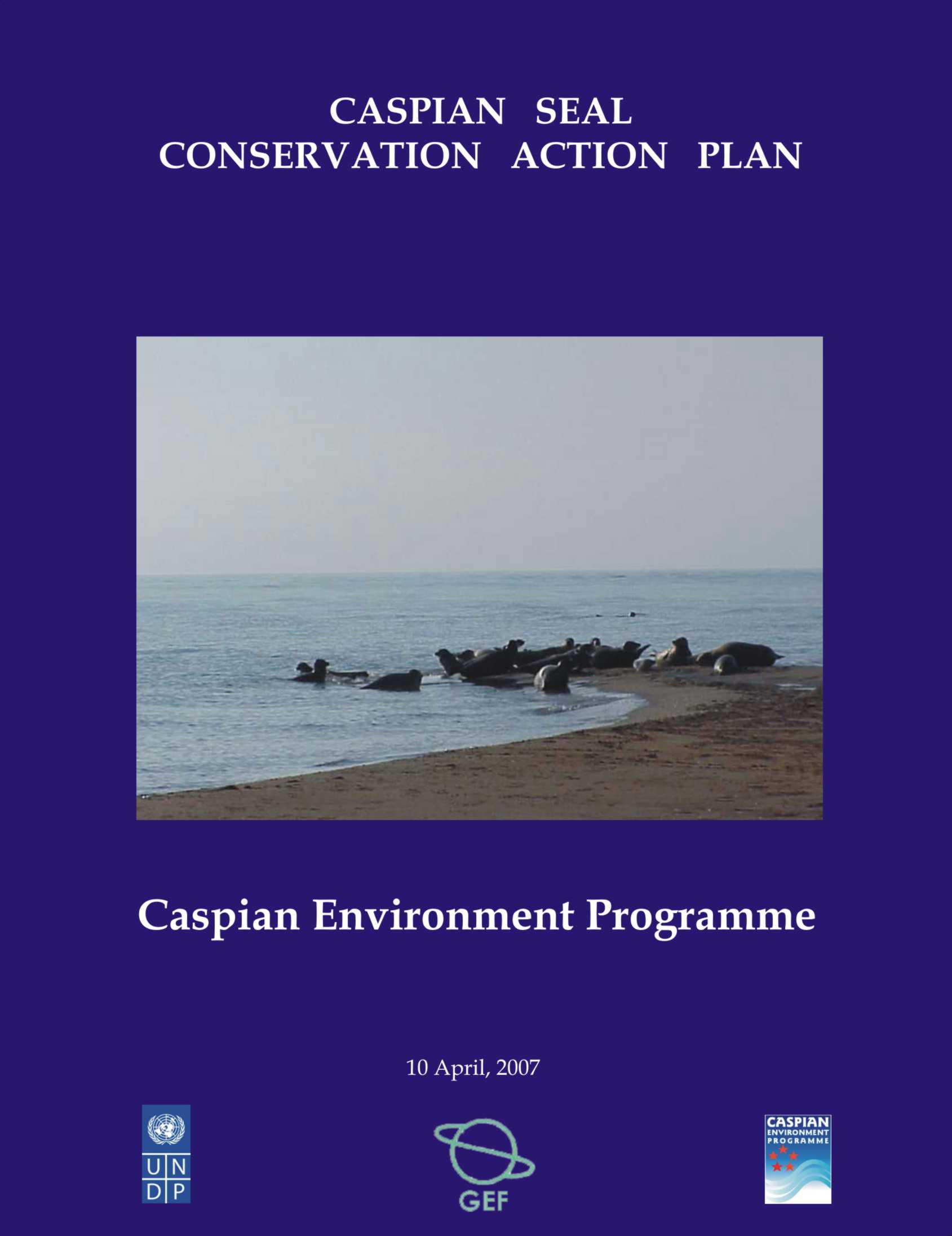
CASPIAN SEAL CONSERVATION ACTION PLAN
10 April, 2007
CASPIAN SEAL CONSERVATION ACTION PLAN
INTRODUCTION
Background
The seal is the only marine mammal in the Caspian Sea, feeding on tulkas and
other small fish, and preyed upon by land animals. It is an endemic species for the
Caspian Sea and is vulnerable on that point of view. During its life history the Caspian
seal migrates from the frozen North Caspian waters in the winter to the South Caspian in
the summer timer and back to the North to give birth to the pups on the ice. During these
migration time the seals can be found everywhere in the sea.
It is unclear how many seals remain in the Caspian Sea today. The seal
population have been estimated at more than 1 million in the early 20th century, at the
present time the population estimates vary from about 110,000 to 350,000. For much of
the 19th and 20th century, hunting was carried out including hunting on the seal pups in
the frozen North Caspian Sea. In the early 20th century, nearly 100,000 seals were
hunted each year by the hunt; later a quota was set at 40,000 seals per year. Then later
20,000 seals, and now it is as low as few thousands. Even these quotas are not fulfilled
now on a full scale. For the past decade, no organized hunting has taken place in the
North Caspian, not for the lack of a quota, but rather for lack in the market for the seal
products.
The IUCN Red List of Threatened Animals has listed the Caspian seal as
vulnerable mammal; the seal has been the victim of recent mass mortalities that have
reduced the population even further. In 2000, a mass mortality caused some tens of
thousands of deaths throughout the Caspian (Azerbaijan, Kazakhstan, Russia, and
Turkmenistan). Scientists have long known that the Caspian Sea has accumulated
parasitic infection, heavy metals, and organic pesticides (especially DDT and its by-
products), but the 2000 mortality was particularly notable for the role played by canine
distemper virus (CDV). Nearly all the seals examined in 2000 were test-positive
for this morbilivirus. Earlier studies have shown that pollution may cause the females
to become barren (According to findings of Russian scientists up to 40%-70% of females
are thought to be barren). Ratio of barren females changes in years and is still rather high.
Besides pollution and hunting, other stressors act on the Caspian seal population.
A major food source for the seals is the tulka, one of the small and abundant fish of the
Caspian. For the past few decades the tulka stocks have reduced dramatically due to
several reasons: mass mortality in 2001, expanded fishing in the 1995-1999, and
invasion of the ctenophore Mnemiopsis leydiy,
Disturbance on the ice during pupping season and the separation of the pups
from its mothers have became another threat to the seals population, which has been
recognized in the last few years.
Active conservation efforts will be required to assure the Caspian seal does not
eliminate from the Earth. As a major mammal, anchoring one end of the food web, it also
plays an important role in the biodiversity of the Caspian Sea and is a remarkable indicator
of the Caspian ecosystems health.
Geographic scope
The immediate geographic scope of the CSACP is the entire Caspian Sea and low
riches of any rivers flowed in the Caspian Sea, wherever seals could be found.
Purpose and status
Caspian Seal Conservation Action Plan describes main activities needed for the
seal conservation. All Caspian countries are invited to adopt the CSCAP on a voluntary
base. CSCAP is addressed to the unsustainable use of bioresources and threats to
biodiversity, which are prioritized as major environmental concerned areas in the
Strategic Action Plan for the Caspian Sea. It is in correspondence with EQO II
"Conservation of Biodiversity" particularly with Target 1 "Increased regional
collaboration to achieve maximum regional benefits for biodiversity" and Target 2
"Ensure all key species are maintained or restored to viable levels". In the Updated SAP
seal conservation become a separate Target 4 among other targets of EQO 1
"Conservation and sustainable use of bioresources".
Chronology:
1997 First International Investigation of Seal's Mortality in the Caspian Sea;
1999-2002 ECOTOX project under CEP umbrella made investigation of seals
mass mortality in 2000 and accumulation of toxic substances in the seals;
2005 First International Aerial winter seal survey (Kazakhstan part of the
Northern Caspian);
2005 First draft of SCAMP develop by Caspian International seal Survey
(CISS);
2005 Presentation of the First draft of SCAMP on the 2nd BISRAG meeting in
Almaty, 25-26th April, 2005;
2006 Presentation of the first draft of SCAMP on the Steering Committee in
Almaty, 14-15 February, 2006;
2006 Second International Aerial winter seal survey (February, 2006);
2006 Second draft of SCAMP develop by CISS;
2006 Technical expert work-shop on discussion of the second draft under
Darwin Initiative project "Quantification and elimination threats to Caspian Seal",
Baku 15-16 September, 2006;
2006 Presentation of the Second Draft of the SCAMP on the 4th BISRAG
meeting in Baku, 23-24 September, 2006;
2006 Third Draft of CSCAP is developed and presented on the Steering
Committee in Moscow 5-6 December, 2006 by BISRAG Interim Secretariat
2007 The final version of the CSCAP is approved by the current Chairperson of
the Steering Committee on behalf of CEP as a guidance document for voluntary
adherence of the countries on April 10, 2007.
Implementation:
Caspian Seal Conservation Plan is elaborated as an independent guideline document. It is
in correspondence with National Caspian Action Plans and Strategic Plan for the Caspian
Sea. It could be incorporated (in whole or in parts) in NCAPs and/or SAP after approval
by the National Governments or other appropriate Nationals or International
Organizations.
Time period
All activities in the Caspian Seal Conservation Plan are for five years implementation
starting from 2007. After five years the CSCAP need to be revisited and to be prolonged
if appropriate.
Structure
All activities are divided in six groups and presented in a table
CASPIAN SEAL CONSERVATION ACTION PLAN
Agreement area: Caspian Sea
Explanatory note: The measures of the Caspian Seal Conservation Action Plan (CSCAP) are outlined according to the following scheme.
Objectives Outputs
Activities
1. Institutional arrangements
1.1 Establishing of an appropriate body for coordination
·
Establish Regional Seal Centre (RSC), which will ·
Elaborate and agree in countries Provision on
of all measures to conserve seals in the region.
lead and coordinate monitoring and research works
Regional Seal Centre (RSC), its status, relationship
on the seal population in the region .
with other Regional and National bodies;
·
Regional Seal Centre (RSC) shall be established
with a representative from each of the Caspian
littoral States working with the approval of each
State Government;
·
Elaborate principles and protocols on information
exchange between RSC and other Organizations
and Institutions;
·
Special scientific consultative group shall be
establish within RSC with representatives from
each Caspian countries and international
consultants to determine and develop the
necessary conservation measures and programme
for research and monitoring.
2. Conservation of seals and it habitats
2.1. To take appropriate measures for the protection of
To identify and/or create special protected areas for seals ·
Define habitat and diet requirements for the
key habitats and for ensuring the preservation of areas
conservation and to take appropriate measures, i.e.
different age groups;
which are essential to the maintenance of the vital
·
to ensure that the protected areas cover the main ·
Take appropriate measures to survey and
biological functions of seals (breeding, feeding, and rest).
birth, nursery, resting and foraging areas of seals and
identify seal breeding, foraging and resting sites in
ensure that the protected areas cover a sufficient
all seasons in all areas for different age groups
proportion of seals in all seasons in all parts of the
within the jurisdiction of each Caspian State;
Caspian;
·
Take appropriate measures to identify areas
·
to ensure that designations of seal protected areas
within which the highest densities of breeding seals
are based on well-defined criteria of critical habitats,
are most likely to occur on ice;
according with international standards.
·
Develop measures to define new protected areas
and define restricted activities within it. Define any
remedial measures required to restore seal habitat
(haul-out sites).
Objectives Outputs
Activities
2.2. Preservation habitats and seals, within and outside
·
To ensure that the seal reserves are created in ·
Create protected areas (may be seasonal -
protected areas, from undue disturbance or changes
such a way that human impact on disturbance to the
winter) within the ice-field where highest breeding
resulting, directly or indirectly, from human activities.
seal population is limited to a minimum.
seal densities most likely to occur. Elaborate
specific definition of seasonal protected area
allowing seal conservation following seals
movements on the ice according to annual
variations in ice condition;
·
Create if necessary new protected areas at seal
haul-out islands and surrounding water.
·
To reduce disturbance by ice-breakers and other ·
Prepare proposals to make changes in Shipping
shipping.
Regulations and other industrial activity to
circumvent ship ways as far as possible from seal
breeding areas.
·
To reduce the number of seals caught as by-catch ·
Release seals trapped in `pareh' nets (type of
and ensure that seals are not deliberately killed by
beach seining) unharmed;
fishermen.
·
Prevent deliberate killing of seals encountered
during fishing operations such as tulka fishing and
using of gill-nets;
·
In coordination with other designated
organizations strength measures to prevent illegal
setting of fishing nets which may entrap and drown
seals;
·
Research ways of reducing seal by-catch in
legally-set fishing nets.
2.3. Identification areas of degraded seals habitat and
·
To identify haul-out areas for resting and breeding ·
Chart, from historical records, sites used formerly
explore possibilities for restoring such habitat (haul-out
which were formerly used, but which are now not
and at present for seal haul-out, and indicate the
sites) or creating new habitat to compensate.
used, or used less than formerly.
causes for the current disuse; suggest remedial
measures;
·
Investigate possibilities of new seal halt-out
creation.
·
To identify seal foraging areas and determine ·
Identify seal foraging areas by telemetry studies;
extent of obstacles created by fishing nets, industrial ·
Chart fishing nets, boats, industrial installations
installations, etc.
activity etc in those areas and it possible negative
impact on the seals;
Objectives Outputs
Activities
·
Monitor seal diet seasonally, by means of
analysing contents of seal scats collected from
selected haul-out sites to investigate overlapping of
seal feeding ration and fishing activities.
·
To identify areas where Mnemiopsis leidyi could ·
Coordinate with Mnemiopsis and other regional
damage fish stocks important for seal feeding.
monitoring programmes to identify areas and
stocks of possible seals prey species, their
conditions, trends, and main factors of their decline
and overlapping of these areas with seals feeding
ground.
3. Research and Monitoring
3.1. Coordination of research programmes and projects. ·
To establish an overview of recent and ongoing ·
RSC should compile an inventory of recent,
Increasing knowledge of the seals biology and ecology
research projects on seals to ensure information
ongoing and planned research projects on seals in
including harmful effects of human activities on the seal
exchange.
the entire Caspian Sea;
population. Create a scientific basis for measures to
·
Respond appropriately to new findings on
improveseal condition and conservation status.
existing threats, or identification of new threats as
determined by the research and monitoring
programmes;
·
All materials used for making any decisions on
seal management and conservation should be
presented to the public.
·
To carry out a full annual survey on the entire ·
Facilitate the annual aerial survey of the breeding
winter ice-field for pups and adult seals according to
seal population on the winter ice field;
international standards taking into account specific of ·
Train young scientists in practical and theoretical
North Caspian Sea.
methodology of seals counting according to the
best international scientific and ethical standards;
·
RSC to establish and maintain electronic data
base for all aerial survey results;
·
RSC to prepare annual report on population
winter counting according to international
standards.
·
To carry out a counts at seal haul-out sites in non-
·
Facilitate and carry out seal counts at all haul-out
iced areas of the Caspian, simultaneously with the
sites to the possible extent in non-iced areas of the
annual February survey and at other seasons.
Caspian, simultaneously with the annual winter
survey and at other seasons;
Objectives Outputs
Activities
·
RSC to identify and chart all non-iced haul-out
sites in the Caspian Sea;
·
RSC to establish and maintain electronic data
base for non-iced seals haul-outs;
·
RSC to prepare annual report of seal numbers at
each haul-out site (to the possible extent); data to
be integrated with results of annual winter survey,
where appropriate.
·
To carry out a periodic health survey of the ·
Facilitate a periodical health survey of the
breeding seal population on the winter ice-field using
breeding seal population on the winter ice-field
non-lethal methods, according to the best
using non-lethal methods;
international experience and animal welfare.
·
Train young scientists in practical and theoretical
methodology of seal health survey according to
international scientific and ethical standards;
·
RSC to establish and maintain electronic data
base for all health survey results;
·
RSC to prepare Report of health survey
according to international standards;
·
Arrange for samples to be appropriately
collected, stored and sent to laboratories for
analysis;
·
To identify laboratories where samples may be
analysed to international standards.
·
To describe, investigate and analyse all causes of ·
Basic measurements and description of all seals
mortality.
found dead will be taken;
·
Seals found freshly dead will be necropsied and
samples taken for analysis of health status;
·
RSC to establish and maintain electronic data
base for all dead seals;
·
The long-standing programmes of seal mortality
and dead seals monitoring along the Caspian coast
shall be continued.
·
To carry out a study of seal diet, using non-lethal ·
Develop an otolith guide for Caspian fish;
methods.
·
Develop a project for investigating seal diet by (a)
analysing faecal samples collected from haul-out
Objectives Outputs
Activities
sites and (b) analyse food remains from seals found
dead due to by-catch and other causes.
·
To investigate Caspian seal annual migrations, ·
Develop a tagging and tracking programme for
foraging movements and migration patterns using not
Caspian seals using modern not wounded telemetry
wounded telemetry systems.
system;
·
RSC to establish and maintain electronic data
base storing all tagging and telemetry data.
·
To investigate Caspian seal intraspecies diversity.
·
Develop a project ongenetic diversity and
population validity of seal breaded on isle
Ogurchinskiy using modern methods of biochemical
and genetic analyses.
3.2 Research of pollution impact to seals and develop
·
Scientific research of seals as one of indicator ·
Collect samples of blubber and other tissues for
measures to reduce such impact
species of the condition of the marine environment.
analysis together with measurements of body
length, blubber thickness and age from seals found
dead from natural causes or in by-catch;
·
Initiate research on mechanisms of pollution
impact to the seals in Caspian Sea.
·
Coordinate with other ecological monitoring ·
Submit data on accumulation of pollutants in
programmes in the region dealing with pollutants.
seals to other ecological programmes.;
·
Elaborated protocols of data exchange with other
ecological programmes in the Caspian region.
3.3 Methodology research
·
Compare different methods of seal count and · RSC in consultation with national and international
elaborate uniform method for the Caspian Sea,
experts in seals' biology make a wide discussion on
according to international standards
possible methods of seal count and elaborate
uniform method for future research according to
international standards. If necessary make
comparative counting using different methods.
·
Develop modern non-lethal methods of seal's ·
RSC to develop a programme for young
investigation for the Caspian sea
scientists training in modern, non-lethal methods of
seal's investigation according to international
standards.
·
Revisit status of Caspian seal population in ·
Search feasibility of including Caspian seal in the
international documents.
CITES list;
·
Search feasibility of changing status of Caspian
seal in the IUCN list.
Objectives Outputs
Activities
4. Reducing of seal taking of
4.1. Reducing and/or prohibition the hunting and the
·
Countries could make their decision on seals ·
RSC elaborate recommendations on
taking of Caspian seals on the period of its population
taking of with consideration of recommendation
reduction/prohibition of seal hunting with further
decline
of RSC. The taking of seals could be prohibited,
submitting to the Commission of Aquatic
if such recommendation will be make by RSC
Bioresources or other designated bodies
and approved by Commission for Aquatic ·
If necessary, prepare proposals to make an
Bioresources
appropriate changing in national legislation through
the proper channels.
4.2. The competent authorities may grant permissions to
seals taking of (other than official hunting) in next cases:
· For national, regional, international Institutions ·
RSC should prepare recommendations to ·
RSC should meet to consider any applications
or teams to be designated performing scientific
National Governments and Commission for
from national, regional, international Institutions or
research into the conservation of the Caspian
Aquatic Bioresources of the Caspian Sea on
teams for taking of seals for scientific researches
seal population or the conservation of the
each event of taking of seals for scientific
with further submitting of recommendations to the
Caspian Sea ecosystem, insofar as the
researches.
designated organizations.
information required for such research cannot
be obtained in any other way;
·
Prevention of groundless taken seals into captivity ·
All permissions for taking seals into captivity for
for scientific research.
research should be evaluated by RSC, and
recommendation should be addressed to
competent organs;
·
Develop special recommendation on kept seals
into captivity for scientific research if (a) animal
welfare conditions can be met and (b) the research
is deemed to be necessary for seal conservation
and scientifically sound according to international
standards.
· For Institutions to be designated nursing seals
·
If necessary seal rehabilitation facilities, can be ·
Rehabilitation programme can be developed as
insofar as these are diseased or weakened
designed
conservation, welfare and rehabilitation tool if
seals or evidently abandoned suckling seal
necessary.
pups, in order to release them after recovery
· For Institutions to be designated as educational ·
Prevention of useless kept seals in public aquaria.
·
A rehabilitation facility and public aquarium might
aquaria for the public
be combined, if deemed to be appropriate by RSC;
·
Develop special recommendation on kept seals
in public aquaria if (a) standards of animal welfare,
Objectives Outputs
Activities
display and educational criteria are met by the
aquaria and (b) the aquaria is demonstrably serves
in the regional public interest and serves a strong
educational and conservation purpose.
· In prevention of further suffering of death-
·
Seals which are clearly suffering and cannot ·
An appropriate changing in national legislation
sick animals
survive may be humanely euthanized
should be done with a list of persons and\or
organizations designated to make euthanizes (fully
qualified veterinarian or biologist)
·
Each euthanize need to be provided with
a) full report of the event and the burial of the
carcasses
b) a necropsy and tissue sampling
c) no parts of the body are given for sale or
monetary gain
4.3. Prevention of illegal hunting and other illegal taking
·
Create effective overseeing system coordinated by ·
Establish a region-wide agreement applicable to
of seals.
state administrative agencies, which should
all countries that disallows any deliberate injuring,
concerned all seal matters
killing or taking of seals without a special
permission issued by competent organs;
·
This agreement should include seals at haul-out
sites, seals in seal-fisheries interactions, and seals
in scientific research;
·
Establish overseeing system in all existing
reserves and other protected areas through the
Caspian Sea guided by an uniform standard;
·
Strength a system preventing illegal hunting in
the seal breeding areas in the ice-field, by using
satellite surveillance, regulation of markets for seal
products (such as sealskin), and other appropriate
measures.
5. Public information
5.1. General public awareness of the conservation status ·
To inform the public throughout the region on ·
RSC should establish and maintain Caspian seal
of the population, conservation measures, and population
implementation of the Caspian Seal Conservation
information web-site in different languages;
condition of the seal in the Caspian Sea
Action Plan (CSCAP).
·
RSC should publish brochures, posters and
·
Provide unified understanding of seal migration
leaflets to enhance public awareness;
through all Caspian Sea and it importance in the ·
RSC to have a qualified, full- or part-time public
Objectives Outputs
Activities
Caspian Sea ecosystem.
awareness officer to take care of public information;
·
To inform the public when they could disturb seals, ·
RSC avoid publishing information, which could
what can be the negative consequences of such
lead to increasing of deliberate illegal killing of
disturb and how they can avoid it.
seals;
·
To inform the public what to do in the event of ·
RSC should publish all data obtained from seals
finding an alive, sick or dead seal on the beach.
count survey, seals health surveys, and
investigation of seals mortalities events in scientific
journals, make these materials transparent, and
available to national and international institutions,
Governments of all Caspian countries, all relevant
conservation and management authorities in the
Caspian region, and general public.
6. Financial implication
·
Incorporate CSCAP in National and Regional ·
Presenting CSCAP to appropriate National and
Strategic Action Plans.
Regional organizations through proper channels for
endorsement and financial support.
·
Informing of International organization on the ·
Develop international projects dealing with
status of Caspian seal and present condition of it
conservation and investigation of the Caspian seal
population.
and submit it to the appropriate Organizations.
Document Outline
- CSCAP Cover_2.jpg
- CSCAP final approved_eng.pdf
- CSCAP Cover.jpg
- CSCAP final approved_eng.pdf